
Champaign Previous-Resident Sources by Era
Choose the source by date, not convenience. Modern parcel cards are rich but do not reach the nineteenth century. Directories have irregular runs, and a deed index proves ownership events rather than all previous residents. The strongest result uses two independent records close to the target year.
| Source | Years covered | Where held | What it shows |
|---|---|---|---|
| IRAD deed index | 1833-1927 | Illinois Archives/IRAD | Historical transfer index |
| IRAD deed record | 1833-1902 | Illinois Archives/IRAD | Recorded deed holdings |
| County tax portal | Sample selector 1985-2026 | Devnet Wedge | Tax cards, sales, owner line |
| Johnson directories | 1878-1970 series | UIUC and CCHA | Names, addresses, phones, routes |
| Sanborn examples | 1887-1915 editions | State Library and LOC | Building use and footprint |
| City permits | Through 2024 / from 2025 | eTRAKiT / OpenGov | Permit and inspection chronology |
Federal census schedules add household detail under the 72-year release rule. Non-current Circuit Court material at the library spans 1833 through the 1990s, but access rules still apply. Save an exact year before opening a source.
Find Past Champaign Residents by Year
The Champaign County Genealogical Society holdings list answers the key question: which directory years exist? County titles include scattered years from 1878-79 through 1950. Johnson's Urbana-Champaign holdings extend as a series from 1878 through 1970, with many specific volumes listed. Some county books include rural routes and nearby towns, so the volume title and section matter.
The UIUC digitized Johnson series provides direct scans for selected years, including 1922, 1925, 1927, 1935 through 1938, and 1940.
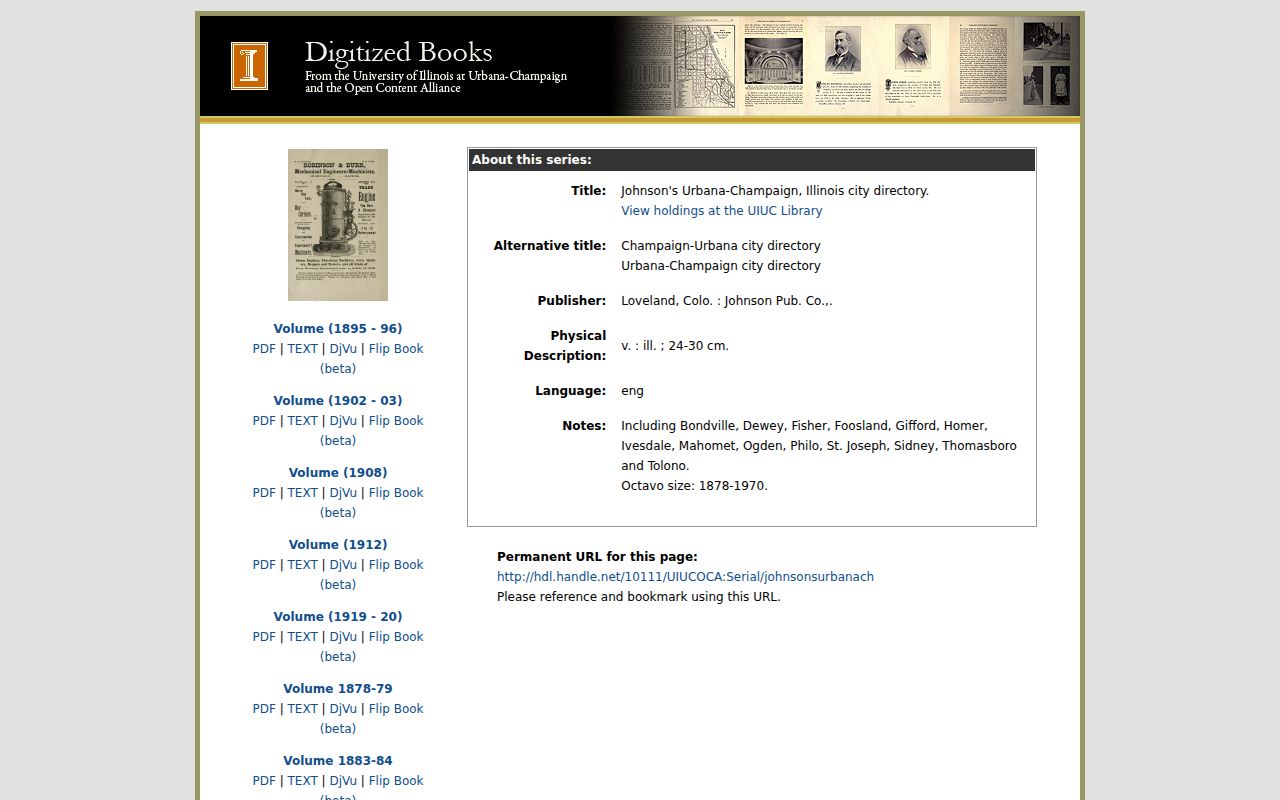
The captured landing page lets a researcher choose a dated volume before searching a household. It also prevents a missing year from being mistaken for a missing person.
The full publication shelf, publishers, and entry styles are covered on the Champaign city directory page. For house history, use only the street and household details needed to follow one address backward.
Walk Champaign Property Records Backward
Begin with the current parcel in the County Property Tax Inquiry. Copy its PIN and legal description. Then use the CCGISC Recorded Deed History Search, which accepts a PIN and orders results by document number, date, or type. The page warns that its deed results may not be complete and may show only one party from a multi-party instrument.
- Open the current tax card and record the PIN, situs, owner line, tax year, and legal description.
- Find the current purchase or transfer in the deed index. Save the instrument number and recording date.
- Read the deed image when available. The seller is the grantor; the receiver is the grantee.
- Search the prior owner's purchase, then repeat the same move backward.
- When online coverage ends, use the IRAD deed index and deed-record holdings or contact the Recorder for the older book.
- Grantor
- The party transferring an interest in land.
- Grantee
- The party receiving that interest.
- Chain of title
- The linked sequence of recorded transfers for one property.
- Legal description
- The lot, block, subdivision, or measured land description that can outlast a street number.
Tapestry adds search fields for names, instrument numbers, types, date ranges, subdivision, lot, block, parcel, and metes-and-bounds. Image access may require payment. The current local online starting date was not confirmed, so never state that a failed web search proves no deed exists.
Pair Champaign Directories and Census
Deeds follow owners. Directories and census schedules can reveal past residents who did not own the property. Work from a directory year toward the nearest released census, but expect different publication and enumeration dates.
- Find the address in a dated street section, then save the printed street form and page heading.
- Read the named entry for address, telephone exchange, marks, and year context.
- Search the nearest released census by city, township, street, and household.
- Compare names, ages, relationships, and nearby households without assuming every match is the same person.
- Repeat with the next available directory year to bracket a move into or out of the address.
A separately titled Champaign criss-cross series with a full year run was not located. Street-oriented sections can still work as partial address indexes. Ask the Champaign County Historical Archives whether reverse directories or telephone books are cataloged under another title.
Order Champaign Resident Records Precisely
The Champaign County Historical Archives occupies the second floor of the Urbana Free Library at 210 W Green Street in Urbana. Its local-history work spans the 1830s to the present and includes more than 300 special collections. Appointments are preferred, and staff may need 48 hours to retrieve special materials.
Remote help works best with an exact citation. The archive copy service handles indexed items or a known newspaper date. Research costs a non-refundable $10 per 10 items, plus 50 cents per page or scan and postage. That is a route for a defined address, name, title, year, and page, not an open-ended search.
Note: Give archive staff the collection number, date span, box or folder clue, and exact address form whenever those details are known.
Map Previous Champaign Residents
Sanborn fire-insurance maps add physical facts that names alone cannot supply. An Illinois State Library comparison follows one downtown Champaign corner across editions from 1887, 1892, 1897, 1902, 1909, and 1915. Building stories, uses, fire escapes, and gasoline tanks change between sheets. Compare the correct edition and sheet, since a Sanborn map is not a resident roll.
The 1869 Library of Congress bird's-eye map places rail lines, two depots, schools, churches, a park, and gas works in the early city. It provides visual context for previous residents, but its perspective is not a survey. Match landmarks against plats, deeds, and later street maps before claiming that an old and new address describe the same parcel.
Track Champaign Residents Through Permits
City permit history has a firm portal split. eTRAKiT covers permits on or before December 31, 2024. OpenGov covers permits on or after January 1, 2025. Search both when a remodel, addition, or inspection may explain a change in use or address.
Permit records can name contacts and show reviews, inspections, conditions, and chronology. They do not prove that a contact was a resident. Tie the permit back to the parcel, date, and legal description, especially when one parcel contains several units or main addresses.
Close a Champaign Resident Trail
Obituaries, newspapers, probate files, naturalization material, and cemetery records can explain why a person leaves the directory trail. The Urbana Free Library links News-Gazette full text from June 1997 to the present and holds indexed local material. No complete all-years obituary index was found, so use a known name and date rather than assuming silence means no notice exists.
Probate and court files may identify heirs or property, but public access depends on the record and its status. A directory match is a lead, not proof that every same-name legal file belongs to the same past resident. Compare dates, street, relatives, and source context.
Missing Champaign Resident Years
Champaign directory runs are irregular. IRAD deed indexes and deed records end at different years. Online deed coverage has an unconfirmed cutoff, and historical maps appear only in selected editions. A missing name can mean the volume was not published, the household fell outside the compiler's route, the address changed form, or the scan lacks the needed page.
Record negative searches with the title, year, search spelling, and access date. Then switch source types. A deed can bridge owners across a directory gap, a census can rebuild a household, and a Sanborn sheet can test whether the building existed.
Lawful use. Research Champaign previous residents for house history, genealogy, heirs, or personal curiosity. Do not use old or current address details to stalk, harass, threaten, or track anyone.