
Find Champaign Neighbors by Block
Public records describe a Champaign block in layers. CCGISC shows parcel shapes and their spatial relationship. The tax portal adds the listed owner and mailing line for one parcel. City registry pages identify neighborhood organizations and leaders, not every person on the block. Historical street sections provide dated names. The Illinois voter system is limited to a known person's status check and cannot supply a public roster of nearby residents.
| Source | What it shows about a block | Access |
|---|---|---|
| CCGISC parcel viewer | Parcel boundaries, subdivisions, layers, adjacent geometry | Public map with general-index disclaimer |
| Address/Street Query | Sites or segments intersecting a shape or buffer | Public app with data-minimization limits |
| City address layer | Address authority, parcel, ZIP, anomaly and status | Public City schema |
| Neighborhood registry | Group category and organizational contact | Public organization page, no member roll |
| Historical street directory | Dated names at addresses along a block | Archive or scan, year-specific |
| Voter data | Limited registration and district context | Redacted and purpose-restricted |
An owner name is not proof of an occupant. A mailing address can differ from the parcel's site address, and one parcel may hold several units. Describe each hit as a record about property, an organization, or a dated directory entry. Do not turn map adjacency into a claim that people are socially connected.
Map Champaign Neighbors Around You
The adjacent-parcel method begins at one known address and moves only to the polygons that touch or sit directly across the street. The CCGISC Public GIS documents address, PIN, and intersection searches, parcel pop-ups, map arrows, pan and zoom controls, measurements, queries, and layers. Each result should retain the parcel number, map layer, access date, and spatial relation.
- Accept the map terms, search the full address, and confirm the selected parcel rather than the nearest label.
- Open the parcel pop-up. Record the PIN and site address before clicking each touching polygon.
- Check only the parcels needed for the immediate block. Compare their site and tax mailing fields without assuming owner occupancy.
- Save the layer date and note whether the parcel is adjacent, opposite, or merely within the map view.
A whole named street needs a broader pass through address and deed records. Use the Champaign street directory when the question extends beyond the immediate block.
Champaign Block Buffers and Addresses
The CCGISC Address/Street Query can select street segments or site addresses that intersect a drawn shape or a set buffer distance. A buffer is a measured zone around a point or line. It is useful for defining a small study area consistently. The result is geometry, not a social circle. Wider buffers collect more unrelated parcels and create more personal data than most block questions need.
The official application overview also describes taxpayer or subdivision queries, map-extent filters, attribute-table selection, exports, and a Street View link. Use the smallest shape that answers the question. An exterior image may add physical context, but it is not an ownership record. A mailing-address export, where allowed, remains tax-contact data and should not be presented as a current household list.
Note: A shape or buffer shows map proximity only; it never proves friendship, kinship, occupancy, or shared activity among Champaign neighbors.
Champaign Site and Mailing Addresses
CCGISC's data guide separates site addresses from tax mailing addresses. The site, also called the situs, identifies where the parcel sits. The mailing line identifies where the tax contact receives mail. Those may match, but a match alone does not prove the owner lives there. The guide also accounts for primary addresses, multiple-address parcels, main addresses, and subaddresses.
- Parcel
- A mapped unit of land with a county property identification number.
- Situs address
- The physical address assigned to the property.
- Tax mailing address
- The destination used for tax correspondence, which may be elsewhere.
- Buffer
- A measured map area drawn around a point, line, or shape.
Multi-unit buildings make the difference vital. A parcel may have several main building addresses or units while the general layer displays one primary address. A parcel-based neighbor lookup can therefore undercount separate addresses or suggest one household where several units exist. Report the layer structure instead of filling the gap with guesses.
Champaign Neighborhood Group Directory
The City registry sorts local groups into homeowner associations, lakeowner associations, neighborhood associations, and Neighborhood Watch groups. Its pages publish registration details and organizational contacts. They do not provide a membership list. Named associations include 500–800 W Washington, Beardsley Park, BPM², Carver Park, Clark Park, Garden Park & Edgebrook, Garwood, Holiday Park, Martin Luther King Subdivision, Ridgewood South, and United Garden Hills.
| Community layer | Examples found | What the City page offers |
|---|---|---|
| Registered associations | Beardsley Park, Clark Park, Holiday Park | Group name and leader/contact route |
| More registered groups | Garwood, Ridgewood South, United Garden Hills | Organization listing; details can change |
| Watch groups | Edgebrook, Jordan Drive, North Willis, West Haven | Organizing rules, not a resident directory |
| Engagement | Quarterly leaders' huddles | City support and public engagement route |
The Champaign neighborhood registry is the best official starting point. Boundaries and contacts may change, so verify the live page before reaching a group. Contact an organization about its public work, not for private member information.
How Champaign Watch Groups Organize
Champaign's published Watch rules show the difference between an organization and a directory of neighbors. The City describes a group as involving at least ten homes, fifty percent active participation, and two meetings per year. Listed names include GHMC, Mittendorf, Neighbors Old Warson, South Ridgeway, South Willis, and Victor Street, among others. Those names document civic organization, not the identity of every participant.
The City's engagement page describes quarterly leader huddles and technical support. That public path can help a resident learn whether a group serves the area around an address. It does not authorize copying contact data into a household profile. Ask the listed leader about public meeting information or how to join through the group's own process.
Practical limit. Use a public group contact to connect with the organization. Do not treat its name or boundary as proof that any nearby household belongs.
Past Champaign Neighbors by Street
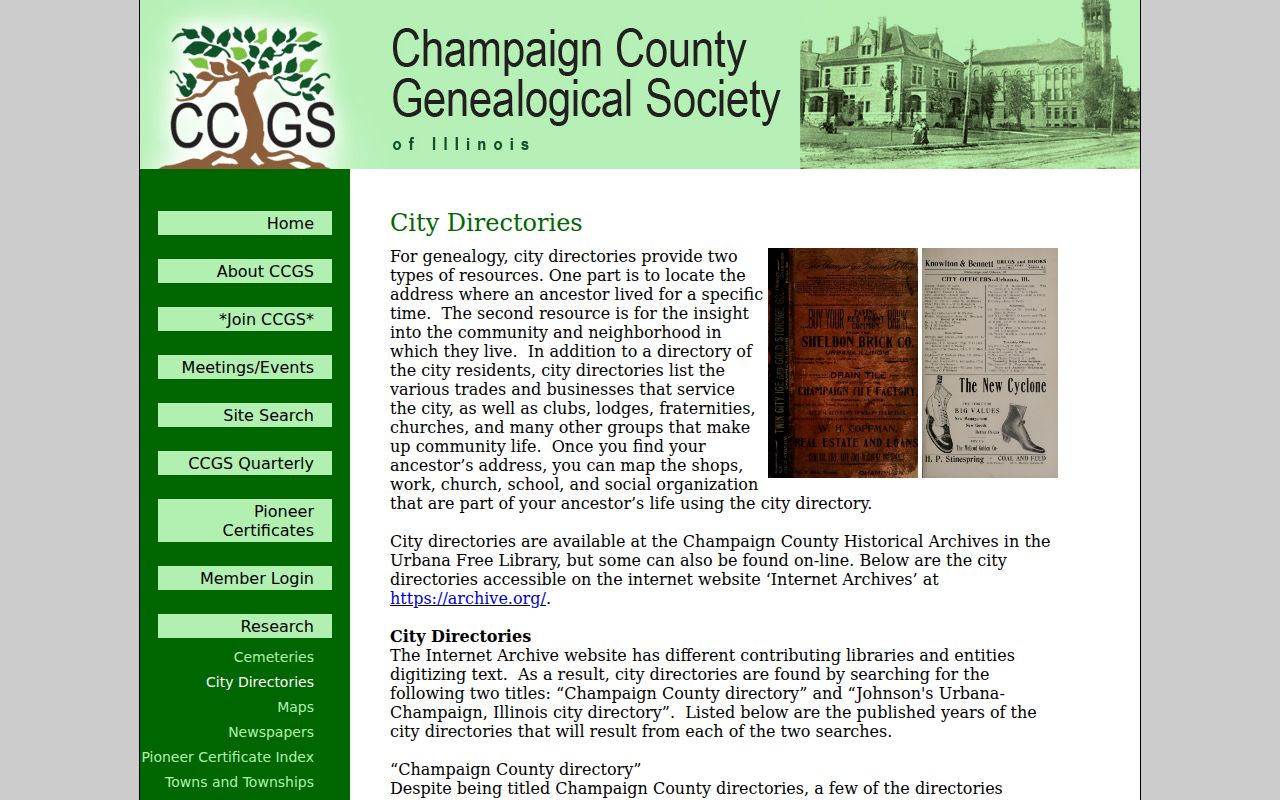
A current parcel map can be paired with a dated street section when the goal is local history. The Champaign County Genealogical Society inventory lists directory titles and years, including volumes with street sections, rural routes, churches, groups, and ads. The source is historical. It should never be mixed into a claim about a present household.
Review the CCGS directory holdings inventory before requesting a volume. Its captured title-and-year list helps identify which edition may contain the block.
Once a year and title are known, search the street section for the address and nearby entries. Preserve old street spelling, rural-route wording, and telephone exchange format. A missing entry may reflect an absent edition, a publication cutoff, or a building that was not listed.
Champaign Neighbor Archive Copies
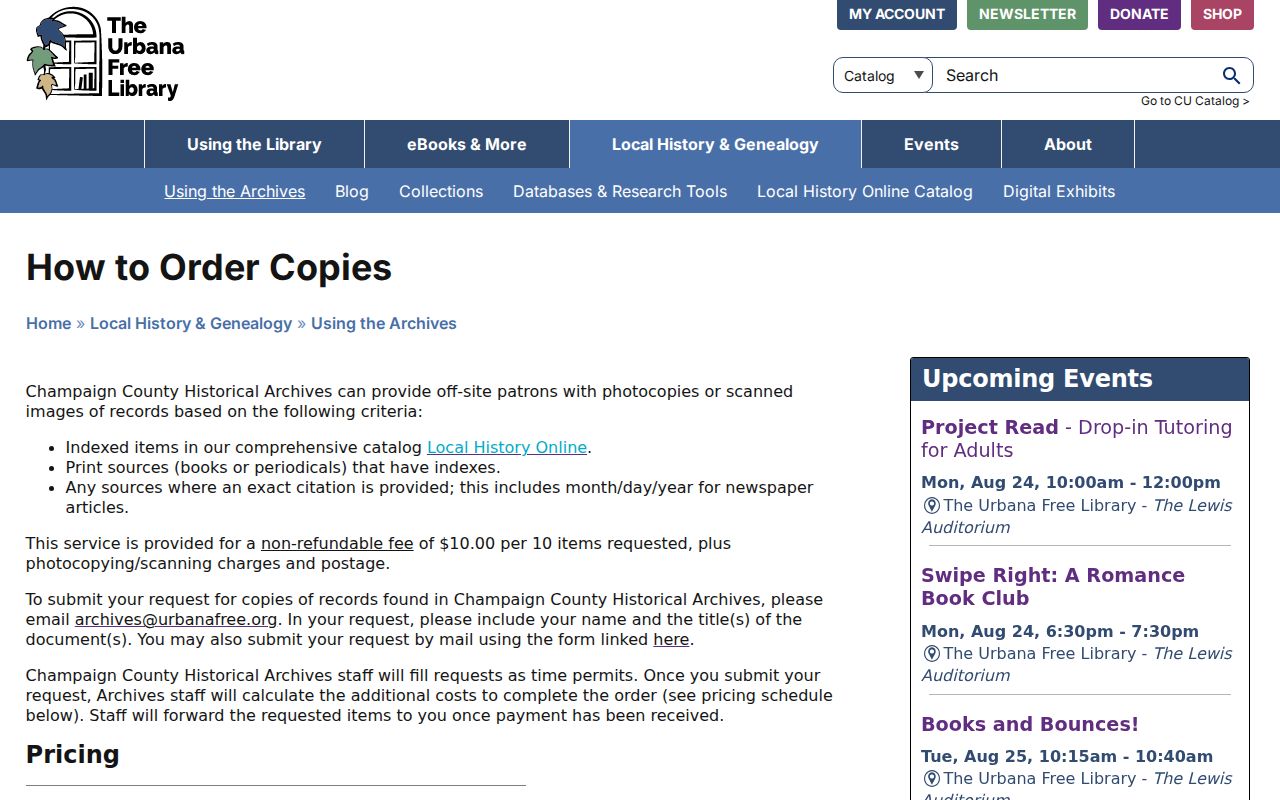
The Champaign County Historical Archives at the Urbana Free Library offers a fallback when an edition or item is not online. Remote staff need a defined citation rather than an open-ended search. The documented process charges $10 for up to ten items, plus page or scan costs and postage. Special collections may need advance retrieval time.
The archive copy-order instructions explain the required citation and limits. The captured rules make clear why title, year, page, street, and address should be gathered first.
This is a strong human-use path for a family-history question or a study of a past block. It avoids asking staff to compile an undefined list of current people and produces a source that can be cited by edition and page.
Note: The county seat and the historical archive are in Urbana even when the address being studied is in Champaign.
Official Champaign Neighbor Sources
Official rolls and commercial neighbor tools differ most in traceability. A county parcel result supplies a PIN, a named keeper, and a dated tax or map context. A City group page identifies an organization and public contact. A commercial category may merge names, phones, and addresses from unknown dates, then suggest links the source records never made.
| Source type | Strength | Main limit |
|---|---|---|
| County GIS or tax record | Direct parcel and owner context | Owner is not always occupant |
| City organization page | Current official contact route | No household membership roll |
| Historical directory | Dated address and name evidence | Old and sometimes incomplete |
| Commercial category | Broad hints may be quick | Unclear sources, dates, and inferred links |
Prefer the record whose keeper can explain or correct it. If sources conflict, keep both dates and fields rather than combining them into a new profile. The narrowest official source usually gives the clearest answer.
Protect Champaign Neighbors' Privacy
Public map access does not make every household fact public. Utility customer data, delivery details, DMV addresses, private occupants, and household members are outside the ordinary block record. Illinois statewide voter data removes street numbers and sensitive fields, while full computerized files are restricted by requester and purpose. The one-person voter lookup requires details already known and is not a block-search shortcut.
The Illinois Attorney General's Address Confidentiality Program provides a substitute address and protected handling for eligible survivors and household members. Records must not be combined to reverse-engineer a protected location. An absent address may reflect legal protection, a source limit, or a data gap.
Lawful use. Learn about a Champaign block for civic interest, family history, reconnection, or personal safety. Never watch, threaten, harass, or intimidate your neighbors.
A sound neighbor lookup ends with a modest statement: which parcels touch, which owners the current roll names, which public group serves the area, or which dated directory lists the old block. It does not claim more than the source proves.